Lectures & Tutorials
Your First Superconducting Qubit: Intro to cQED, Part II
Part of the series Superconducting Qubits 101; cited as one entry below.
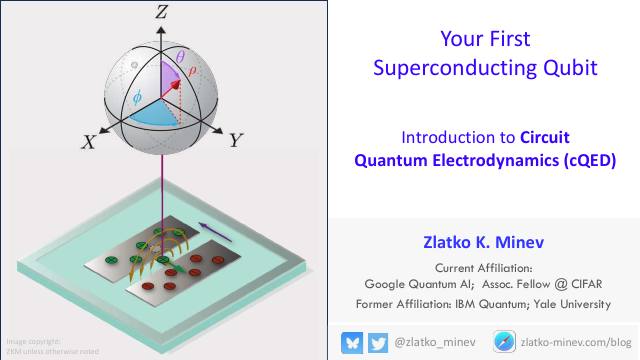
Second half of a beginner cQED lecture titled "Your First Superconducting Qubit". It goes from Dirac's canonical quantization and ladder operators to the transmon treated as a weakly nonlinear (Kerr) oscillator, then shows how real devices are modeled: classical EM simulation, quantization (with energy-participation ratios as the worked example), and the effective Hamiltonian with dispersive shifts. Backup slides hold hand-written notes on energy, flux fluctuations and the compactness of the junction phase.
- Canonical quantization: Poisson brackets to commutators, ladder operators, Husimi Q phase-space pictures
- Transmon as a Kerr oscillator: to first order (in the RWA) the nonlinearity shifts energies, giving anharmonicity and a Lamb shift, while the Fock eigenstates are unchanged
- Three-step device modeling: EM eigenmodes, quantization via EPR, and the effective qubit-cavity Hamiltonian with cross-Kerr chi
- Backup notes on flux fluctuations, harmonic approximation and a tight-binding picture of the junction phase
Summary and key points drafted by a language model from the slides, not yet reviewed by me. The slides are the source.
Cite
@misc{minev2026superconductingqubits101,
  author = {Zlatko K. Minev},
  title = {{Superconducting Qubits 101}},
  howpublished = {Lecture series},
  year = {2026},
  url = {https://zlatko-minev.github.io/zlatko-minev-quantum-repository/series/superconducting-qubits-101/},
  note = {Slides, 7 decks, 2020--2026; given at CEC ICMC; Flagship Quantum Device Workshop (Beginner); QIQT Summer School; Qiskit Global Summer School; Quantum Device Workshop (Beginner)}
}Reuse
Unless a deck says otherwise, the slides and notes here are © Zlatko K. Minev and shared under CC BY-NC-ND 4.0: you're welcome to read, download and share them, unchanged and non-commercially, with credit and a link back. Commercial use or a reworked slide or figure in your own talk, course or paper needs permission; please ask, the answer is usually yes. If you use something in teaching or a publication, I'd love a short note telling me where.
Some slides include figures, photos, logos or excerpts from other people and institutions, credited where they appear. Those aren't mine to license, so please ask the original source. Spotted a missing credit? Tell me and I'll fix it.