Tech Notes
Introduction to Many-Body Physics: Exploring Spin Models for Quantum Computing Scientists
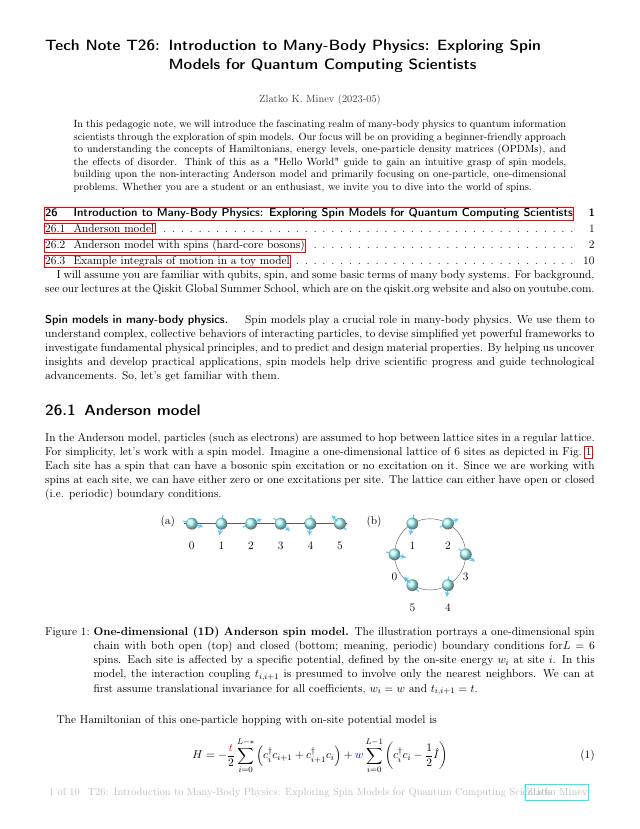
A "Hello World" note introducing many-body physics to quantum information readers through a one-dimensional spin chain. It maps the Anderson hopping model onto qubit Pauli operators, works out the hopping-free case analytically, and plots spectra, spin vectors and one-particle density matrix (OPDM) occupations as hopping is turned on, ending with a toy example of local integrals of motion.
- Anderson model with nearest-neighbor hopping and on-site energy, open and periodic boundaries
- Hard-core bosons as qubits: number-conserving XX+YY hopping and Hamming-weight blocks
- Spin-vector visualization, global magnetization, and OPDM spectra vs. eigenstate
- Integrals of motion in a ZZ toy model, with pointers toward disorder and MBL
Summary and key points drafted by a language model from the slides, not yet reviewed by me. The slides are the source.
Cite
@techreport{minev2023t26,
  author = {Zlatko K. Minev},
  title = {{Introduction to Many-Body Physics: Exploring Spin Models for Quantum Computing Scientists}},
  type = {Technical Note},
  number = {T26},
  institution = {Zlatko's Quantum Notebook},
  year = {2023},
  url = {https://zlatko-minev.github.io/zlatko-minev-quantum-repository/items/t26-introduction-to-many-body-physics-exploring-spin-models/}
}Reuse
Unless a deck says otherwise, the slides and notes here are © Zlatko K. Minev and shared under CC BY-NC-ND 4.0: you're welcome to read, download and share them, unchanged and non-commercially, with credit and a link back. Commercial use or a reworked slide or figure in your own talk, course or paper needs permission; please ask, the answer is usually yes. If you use something in teaching or a publication, I'd love a short note telling me where.
Some slides include figures, photos, logos or excerpts from other people and institutions, credited where they appear. Those aren't mine to license, so please ask the original source. Spotted a missing credit? Tell me and I'll fix it.