Research Talks
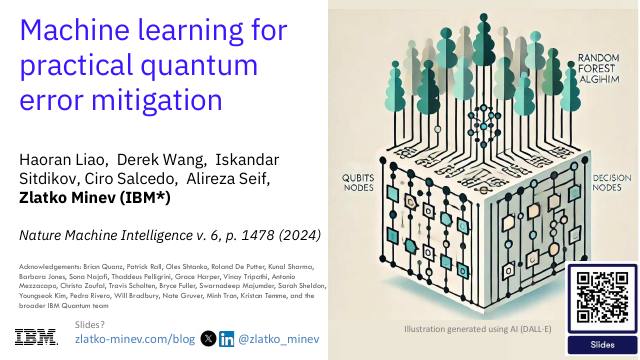
Machine Learning for Practical Quantum Error Mitigation (ML-QEM)
Sets the scene with utility-scale experiments enabled by error mitigation and the sampling-overhead bottleneck of physics-based methods such as ZNE and PEC. It then presents ML-QEM, which learns the map from noisy to ideal expectation values using circuit features, comparing models, adapting to noise drift, and reasoning about why it works. Code and docs are open source.
- Landscape of utility-scale experiments on superconducting processors and the role of error mitigation
- Limits of ZNE and PEC: sampling overhead and the complexity of quantum noise
- ML-QEM models (linear regression, random forest, MLP, GNN); random forest performs best
- Fine-tuning to time-varying noise, and why learning classical output relationships can succeed
Summary and key points drafted by a language model from the slides, not yet reviewed by me. The slides are the source.
Cite
@misc{minev2025machinelearning,
  author = {Zlatko K. Minev},
  title = {{Machine Learning for Practical Quantum Error Mitigation (ML-QEM)}},
  howpublished = {Talk, Aspen AI plus Quantum},
  year = {2025},
  url = {https://zlatko-minev.github.io/zlatko-minev-quantum-repository/items/2025-machine-learning-for-practical-quantum-error/},
  note = {Slides}
}Reuse
Unless a deck says otherwise, the slides and notes here are © Zlatko K. Minev and shared under CC BY-NC-ND 4.0: you're welcome to read, download and share them, unchanged and non-commercially, with credit and a link back. Commercial use or a reworked slide or figure in your own talk, course or paper needs permission; please ask, the answer is usually yes. If you use something in teaching or a publication, I'd love a short note telling me where.
Some slides include figures, photos, logos or excerpts from other people and institutions, credited where they appear. Those aren't mine to license, so please ask the original source. Spotted a missing credit? Tell me and I'll fix it.