Lectures & Tutorials
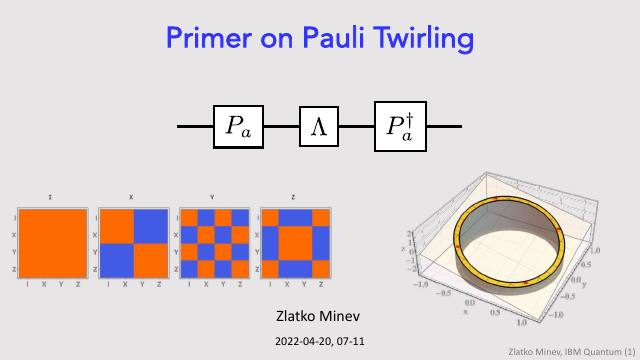
Primer on Pauli Twirling, Part IV
Part of the series Primer on Pauli Twirling (tutorial); cited as one entry below.
Part of a primer on Pauli twirling covering its optional advanced material and a noise-modeling refresher. Classical spherical designs motivate unitary t-designs and where they appear (average fidelity, RB, random twirling); noise is then written as a Pauli channel, a process (chi) matrix and a Pauli transfer matrix, with amplitude damping shown raw and twirled.
- Overview of the twirling primer: operational twirling, why it works, why the Pauli group
- Classical spherical designs as intuition for unitary t-designs and their uses
- Noise models: Pauli channels, chi-matrix representation and Pauli transfer matrix elements
- Amplitude damping applied repeatedly, with and without twirling
Summary and key points drafted by a language model from the slides, not yet reviewed by me. The slides are the source.
Cite
@misc{minev2022primerpaulitwirling,
  author = {Zlatko K. Minev},
  title = {{Primer on Pauli Twirling (tutorial)}},
  howpublished = {Lecture series},
  year = {2022},
  url = {https://zlatko-minev.github.io/zlatko-minev-quantum-repository/series/primer-on-pauli-twirling-tutorial/},
  note = {Slides, 4 decks}
}Reuse
Unless a deck says otherwise, the slides and notes here are © Zlatko K. Minev and shared under CC BY-NC-ND 4.0: you're welcome to read, download and share them, unchanged and non-commercially, with credit and a link back. Commercial use or a reworked slide or figure in your own talk, course or paper needs permission; please ask, the answer is usually yes. If you use something in teaching or a publication, I'd love a short note telling me where.
Some slides include figures, photos, logos or excerpts from other people and institutions, credited where they appear. Those aren't mine to license, so please ask the original source. Spotted a missing credit? Tell me and I'll fix it.