Research Talks
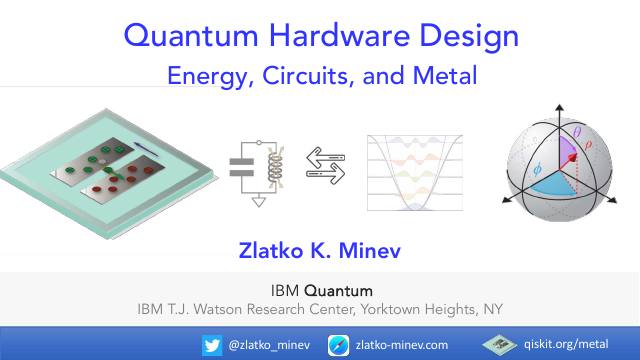
Quantum Hardware Design: Energy, Circuits, Metal (Qiskit Metal, EPR)
Covers the path from physical layout to quantum Hamiltonian. It introduces Qiskit Metal, an open-source tool for building, tuning and analysing superconducting chips with renderers to Ansys HFSS and Q3D, and shows devices made with it. It then explains EPR, which asks where the energy of each mode sits, and modular quasi-lumped oscillator models, comparing both against measured qubit-readout cross-Kerr values.
- Landscape of quantization methods, from lumped to full-wave
- Qiskit Metal: component library, parameter tuning, auto-routing, rendering to HFSS/Q3D
- EPR method: participation of modes in junctions and lossy materials, with theory vs. experiment
- LOM: reducing a capacitance network to dressed subsystem Hamiltonians
Summary and key points drafted by a language model from the slides, not yet reviewed by me. The slides are the source.
Cite
@misc{minev2021quantumhardware,
  author = {Zlatko K. Minev},
  title = {{Quantum Hardware Design: Energy, Circuits, Metal (Qiskit Metal, EPR)}},
  howpublished = {Talk, Qiskit Seminar},
  year = {2021},
  url = {https://zlatko-minev.github.io/zlatko-minev-quantum-repository/items/2021-quantum-hardware-design-energy-circuits-metal-qiskit/},
  note = {Slides}
}Reuse
Unless a deck says otherwise, the slides and notes here are © Zlatko K. Minev and shared under CC BY-NC-ND 4.0: you're welcome to read, download and share them, unchanged and non-commercially, with credit and a link back. Commercial use or a reworked slide or figure in your own talk, course or paper needs permission; please ask, the answer is usually yes. If you use something in teaching or a publication, I'd love a short note telling me where.
Some slides include figures, photos, logos or excerpts from other people and institutions, credited where they appear. Those aren't mine to license, so please ask the original source. Spotted a missing credit? Tell me and I'll fix it.