Research Talks
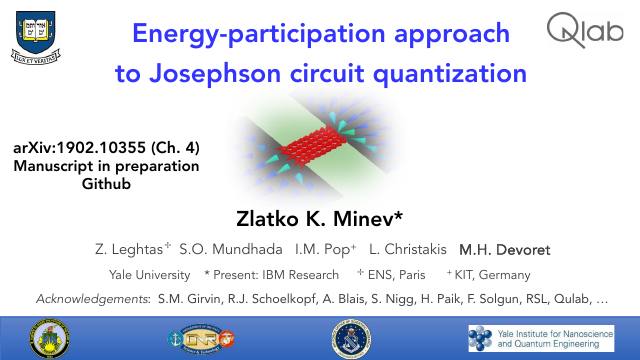
Energy Participation Ratio (EPR) for Superconducting Qubit Design
Presents EPR as a unified way to get both the Hamiltonian and the dissipation budget of a Josephson circuit from a single eigenmode simulation, by asking what fraction of each mode's energy sits in the junction or lossy element. It covers the derivation, sum rules, bright/dark mode intuition, and agreement with experiment across 3D, flip-chip (2.5D) and waveguide devices. Backup slides apply the method to the cross-resonance gate with a direct coupler.
- EPR definition and quantization in the basis of linearized eigenmodes
- Hamiltonian parameters (anharmonicity, cross-Kerr, Lamb shift) and loss EPRs
- Measured vs. predicted results over five orders of magnitude for several architectures
- Cross-resonance gate analysis: ZX rate and spurious terms in the EPR basis
Summary and key points drafted by a language model from the slides, not yet reviewed by me. The slides are the source.
Cite
@misc{minev2019energyparticipation,
  author = {Zlatko K. Minev},
  title = {{Energy Participation Ratio (EPR) for Superconducting Qubit Design}},
  howpublished = {Talk},
  year = {2019},
  url = {https://zlatko-minev.github.io/zlatko-minev-quantum-repository/items/2019-energy-participation-ratio-epr-for-superconducting/},
  note = {Slides}
}Reuse
Unless a deck says otherwise, the slides and notes here are © Zlatko K. Minev and shared under CC BY-NC-ND 4.0: you're welcome to read, download and share them, unchanged and non-commercially, with credit and a link back. Commercial use or a reworked slide or figure in your own talk, course or paper needs permission; please ask, the answer is usually yes. If you use something in teaching or a publication, I'd love a short note telling me where.
Some slides include figures, photos, logos or excerpts from other people and institutions, credited where they appear. Those aren't mine to license, so please ask the original source. Spotted a missing credit? Tell me and I'll fix it.