Research Talks
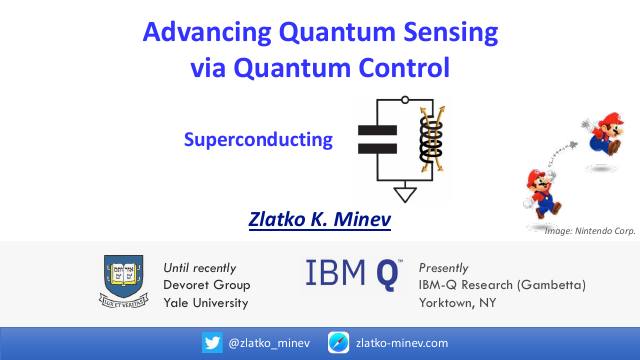
Advancing Quantum Sensing via Quantum Control (keynote)
Frames quantum sensing around measurement and real-time control, giving a primer on continuous quantum measurement, back-action and accuracy versus precision. Introduces superconducting circuits, qubit types, hardware architectures and dispersive readout, surveys sensing with circuits (SQUIDs, noise spectroscopy, charge sensing), and presents the quantum-jump experiment as a case study, with EPR design material in the backup.
- Primer on quantum measurement: demolition vs. non-demolition, continuous monitoring, back-action
- Superconducting qubits and architectures (2D, 2.5D, 3D) and cQED dispersive readout trade-offs
- Survey of sensing with circuits: SQUID magnetometry, flux and charge noise sensing, qubit spectrometry
- Case study: catching and reversing a quantum jump with high-efficiency detection and feedback
Summary and key points drafted by a language model from the slides, not yet reviewed by me. The slides are the source.
Cite
@misc{minev2019advancingquantum,
  author = {Zlatko K. Minev},
  title = {{Advancing Quantum Sensing via Quantum Control (keynote)}},
  howpublished = {Talk, Padua, Italy},
  year = {2019},
  url = {https://zlatko-minev.github.io/zlatko-minev-quantum-repository/items/2019-advancing-quantum-sensing-via-quantum-control/},
  note = {Slides}
}Reuse
Unless a deck says otherwise, the slides and notes here are © Zlatko K. Minev and shared under CC BY-NC-ND 4.0: you're welcome to read, download and share them, unchanged and non-commercially, with credit and a link back. Commercial use or a reworked slide or figure in your own talk, course or paper needs permission; please ask, the answer is usually yes. If you use something in teaching or a publication, I'd love a short note telling me where.
Some slides include figures, photos, logos or excerpts from other people and institutions, credited where they appear. Those aren't mine to license, so please ask the original source. Spotted a missing credit? Tell me and I'll fix it.