Research Talks
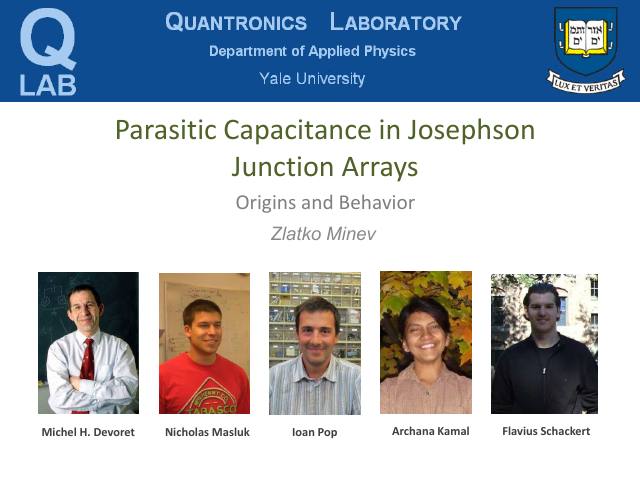
Josephson Junction Arrays: Parasitic Capacitances
Explains why capacitance to ground limits the number of junctions in a fluxonium array, then compares simulated junction capacitances with parallel-plate theory and measured data. It studies how Dolan-bridge geometry affects parasitic capacitance, discusses a bridge-free fabrication alternative, and sketches ongoing work on array Q and faster numerical diagonalization of fluxonium.
- Role of series junction arrays in fluxonium and the limit set by capacitance to ground
- Simulated vs. empirical junction capacitance per area
- Dolan-bridge geometry study and design guidelines for minimizing parasitic capacitance
- Bridge-free junction technique, array loss, and algebraic diagonalization of fluxonium
Summary and key points drafted by a language model from the slides, not yet reviewed by me. The slides are the source.
Cite
@misc{minev2011josephsonjunction,
  author = {Zlatko K. Minev},
  title = {{Josephson Junction Arrays: Parasitic Capacitances}},
  howpublished = {Talk},
  year = {2011},
  url = {https://zlatko-minev.github.io/zlatko-minev-quantum-repository/items/2011-josephson-junction-arrays-parasitic-capacitances/},
  note = {Slides}
}Reuse
Unless a deck says otherwise, the slides and notes here are © Zlatko K. Minev and shared under CC BY-NC-ND 4.0: you're welcome to read, download and share them, unchanged and non-commercially, with credit and a link back. Commercial use or a reworked slide or figure in your own talk, course or paper needs permission; please ask, the answer is usually yes. If you use something in teaching or a publication, I'd love a short note telling me where.
Some slides include figures, photos, logos or excerpts from other people and institutions, credited where they appear. Those aren't mine to license, so please ask the original source. Spotted a missing credit? Tell me and I'll fix it.